With the Article 6.4 mechanism taking shape, forward-thinking organisations should prepare now. In this second part of our series, we outline concrete steps project developers can take today to position themselves for success in this evolving carbon market landscape.
The Article 6.4 mechanism is taking shape, with the Supervisory Body releasing comprehensive guidelines, standards, and procedural documents that will govern how projects are developed, validated, and credited. For project developers, investors, and host countries alike, understanding these new requirements and preparing for their implementation is becoming increasingly important.
How can developers be prepared?
Developers and stakeholders can get ahead by considering three core elements:
1. Assess countries’ preparedness
Before investing in project development, evaluate whether your target country is ready to host Paris Agreement Crediting Mechanism (PACM) projects. Look for some of these indicators:
- The country has designated a national authority for the mechanism.
- It has prepared and communicated a Nationally Determined Contribution (NDC).
- It has indicated a ‘white’ and ‘red’ list of activities considered for the mechanism.
Countries like Bangladesh, Bhutan, and Ghana have already approved various projects for transition, demonstrating early leadership in Article 6.4 engagement. Bangladesh has approved 11 diverse projects spanning solar home systems, energy efficiency initiatives, improved cookstove programmes, and clean water projects. Bhutan is moving forward with three major hydropower projects, while Ghana has approved substantial cookstove programmes.
2. Get documentation in order
The Supervisory Body has released a comprehensive suite of new forms and templates that set a high bar for project transparency. Start getting familiarised with:
- Enhanced environmental and social safeguard requirements.
- New monitoring and reporting templates.
- Updated validation and verification procedures.
Project developers seeking to propose a new activity under the mechanism must demonstrate the ‘potential benefits’ by notifying the UNFCCC Secretariat of their intention to seek registration before starting the project. All prior consideration notifications must be submitted through the designated interface.
3. Align methodology choices to current standards
The Supervisory Body has now issued comprehensive standards for both emissions reductions and removals, providing crucial guidance on how carbon crediting activities should be designed, measured, and verified under PACM.
These standards represent more than just technical requirements; they’re the blueprint for how Article 6.4 will deliver high-integrity climate action on the ground. Notably, elements of these standards may become best practice over time across broader standard setters in the VCM, making it worthwhile for project developers to assess them now and understand their implications, even for projects outside PACM.
PACM standards explained
The Article 6.4 standards establish a comprehensive structure that builds upon established carbon market principles while introducing more stringent requirements for project integrity. These standards fall into two categories:
- Foundational frameworks that define how the mechanism will take shape; and
- Technical standards that ensure the quality of quantification and environmental integrity of carbon projects.
Building the architecture
The methodologies standard provides the outline for how activities should be designed, measured, and verified under Article 6.4. Think of it as the instruction manual for creating the detailed rulebooks or methodologies that projects will follow.
The standard ensures baselines align with Paris Agreement targets and excludes projects that would lock in high-emission infrastructure for decades to come. Importantly, it builds in flexibility for developing countries and small island states, addressing concerns that overly rigid processes might price less wealthy nations out of participating in international mechanisms.
The removals standard recognises CO2 removal at the UN level for the first time, creating a formal international framework for activities that pull greenhouse gases from the atmosphere. Whether through nature-based solutions like reforestation or technological approaches like direct air capture, removal activities face unique challenges around permanence and reversal risk. The standard introduces a buffer pool mechanism where projects contribute credits to a collective insurance fund, with contribution rates scaled to assessed risk levels. It also encourages insurance for avoidable reversals, i.e., those caused by preventable events rather than natural disasters. The distinction between avoidable and unavoidable reversals, along with definitions of what constitutes ‘low-risk’, will need further elaboration as implementation progresses.
Technical standards: Ensuring quantification integrity
The technical standards work as an integrated quality control system. Every methodology developed under Article 6.4 must satisfy these requirements, which address core integrity questions.
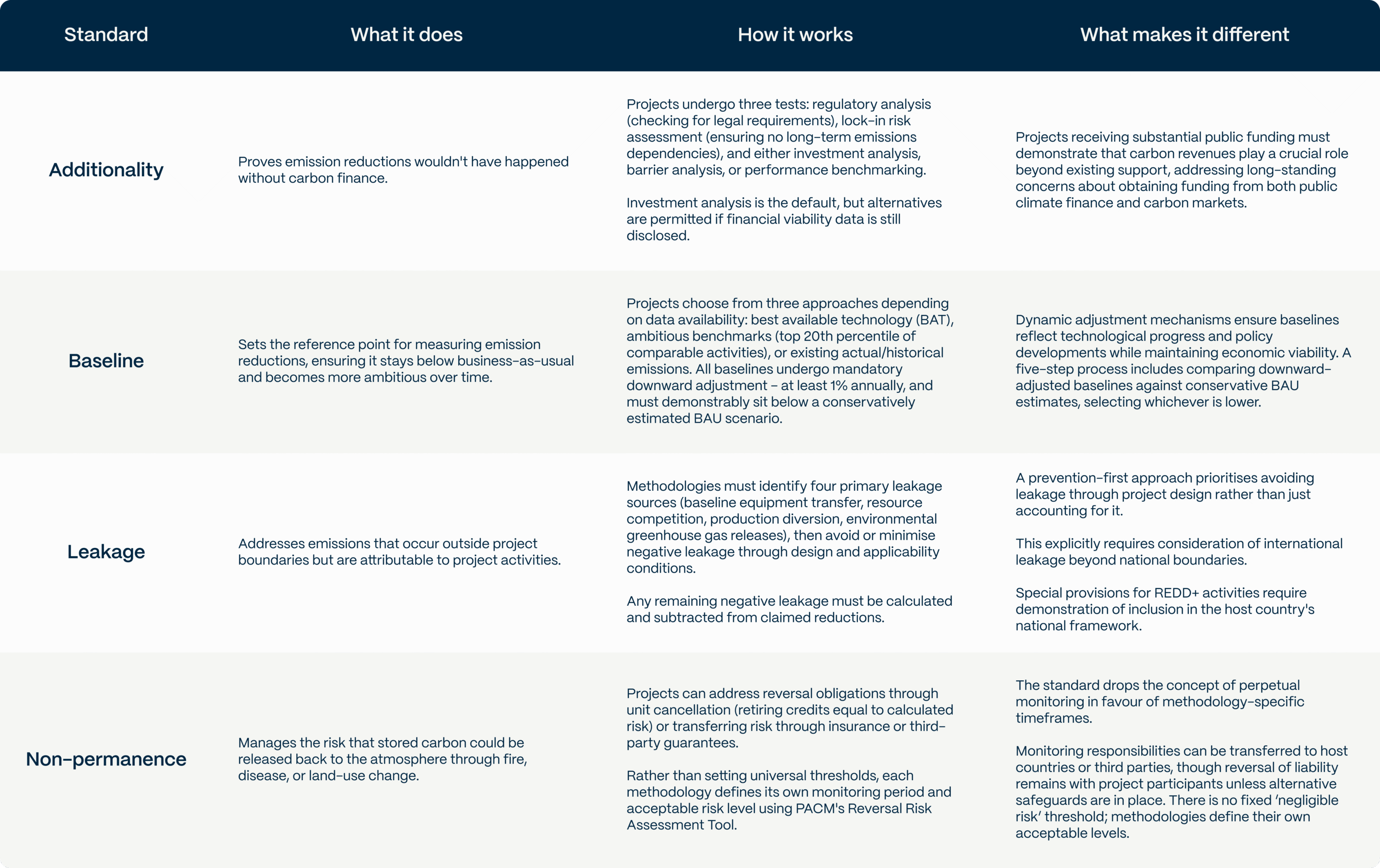
Table 1. A list of Article 6.4 standards and their features
The framework represents a significant evolution from CDM practices, incorporating two decades of lessons learned while introducing mechanisms, particularly the dynamic baseline adjustment and comprehensive leakage framework, designed to maintain environmental integrity as Paris Agreement ambition ratchets upward. Whether this balance between flexibility and rigour succeeds will depend largely on how methodologies implement these standards in practice.
Structure of activities under PACM
One key consideration when transitioning from CDM to PACM is understanding the structure of activities. Under the CDM, there were three types of activities: Project Activities (PAs), Programmes of Activities (PoAs) and Component Project Activities (CPAs).
The structure under PACM will be simplified to encompass only PoAs and PAs. According to the UNFCCC definition, a PoA achieves emission reductions by aggregating hundreds or thousands of individual activities, reducing transition costs for developers.
This aspect should simplify things for those projects transitioning to PACM. However, the new mechanism has complex standards and multiple stakeholders, each with different timelines, so getting ahead will prove advantageous down the line.
Read more from our Article 6.4 series:
01 – Article 6.4 explained: The Paris Agreement Crediting Mechanism state of play
03 – Bridging markets: How Article 6.4 creates new carbon finance opportunities
You can also explore our Article 6.4 theme in the Abatable Platform.
To understand more about how to approach Article 6.4 from a supply or demand perspective, get in touch to speak with one of our experts.