Authors

Contents
Find out how we can help you navigate environmental markets
Scope 3 emissions – those that are generated up and down a company’s value chain – are appearing on an increasing number of company sustainability and risk radars. And for good reason. Scope 3 emissions vary by sector but frequently account for over 70% of a typical company’s total carbon footprint.
As a result, regulators are beginning to set legislation requiring large companies to at least measure their Scope 3 impact, with a view to ultimately reducing these emissions.
Companies have a number of options to address these emissions: they can carefully select suppliers or set supply chain emissions-reduction targets. Certain companies are also looking to implement ‘insetting’ projects. These will see them work with their suppliers and implement projects that reduce emissions directly within their supply chain. When executed correctly, insetting projects can also provide additional positive outcomes for local communities, landscapes and ecosystems.
Insetting has significant potential to address Scope 3. However, according to a new report from Abatable and the International Platform for Insetting (IPI), Addressing Scope 3 – how insetting can be scaled to tackle supply chain emissions, consensus quickly needs to be established on how to precisely define and implement the practice if it is to effectively scale as a credible climate solution.
Alignment needed
The report, which surveys the project developers who are pioneering insetting projects, finds that alignment is sorely needed on insetting best practices and the associated claims companies can make against their overall emissions-reduction targets. This is crucial as companies increasingly look towards insetting as a climate solution amidst increasing public scrutiny over their net-zero plans.
Having sound principles behind the implementation of insetting projects and how companies claim climate and nature benefits from insetting is therefore crucial if the practice is to scale as an effective and credible solution to meet global climate and nature goals.
Boundary disputes
One of the report's main findings is that it is key to establish where the boundaries of insetting lie. There is confusion from market actors, particularly in the agricultural sector, about whether ‘on-farm’ or wider landscape projects constitute insetting.
On the other side of the equation, from a corporate claims perspective market players also stated there is a blurred boundary between where a Scope 3 reduction claim stops and a Beyond Value Chain Mitigation (BVCM) claim (where companies finance additional climate action outside of their value chain) starts.
The lack of clarity from existing standards and frameworks on these points is inhibiting companies from taking action.
How to measure impact?
The report finds that additional consensus is also needed on how insetting is measured, verified and attributed on the project supply side, with guidelines and frameworks still ambiguous or in development.
It also finds that standard setters need to increase alignment and retain a degree of flexibility when defining rules for the sector due to the current state of play of insetting project guidance and methodologies, the current levels of traceability of different agricultural commodities and the availability of data to measure and report on project outcomes.
Modular, adaptable approaches will be needed to balance flexibility with stringency across the various insetting environments.
Finally, it is important that companies recognise that high-quality insetting projects come with a cost, but also that they offer additional longer-term direct business benefits including more resilient supply chains and a shield against future carbon pricing dynamics.
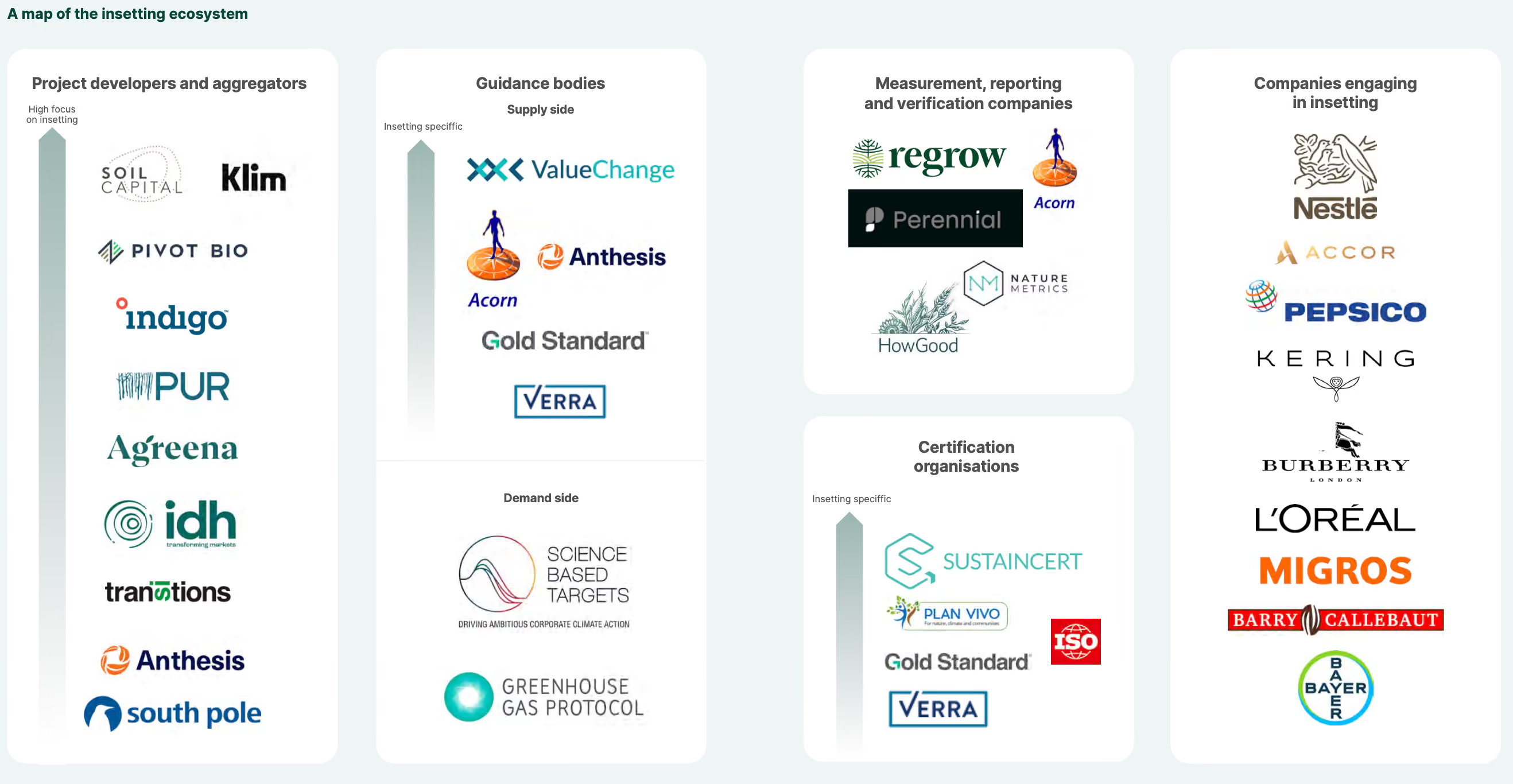
Recommendations
The report outlines a series of recommendations for the main insetting stakeholders:
- Scope 3 and insetting-focused forums: Strengthen the definition of insetting and associated best practices, and differentiate between the different intervention types to protect market integrity.
- Greenhouse gas accounting and standard setters: Take a pragmatic approach when designing guidance around Scope 3 emissions reduction and removal to capture the diverse traceability maturity of different commodities, and include concepts such as supply sheds 1 to incentivise greater adoption of insetting by corporates.
- Corporate target-setting initiatives: Incentivise BVCM and landscape approaches, which contribute to maintaining the world’s natural carbon sinks, as well as the scaling of nascent solutions. Ensure market-based mechanisms count towards emissions-reduction plans while guidance is being finalised.
- Industry collaboration initiatives: Facilitate increased opportunities for corporates to co-invest in insetting projects across production landscapes to scale impact and achieve economies of scale. Establish clear principles to adequately reward farmers for the ecosystem services they are investing in.
- Companies considering insetting: Do not delay climate and nature action – invest in upskilling and aligning your sourcing and sustainability teams on what insetting is and how to integrate it into your business strategy.
- Companies considering and already investing in insetting: Shift your business approach of optimising for competitive sourcing prices to sourcing from supply chains that will be healthy in the future. Don’t squeeze the farmer – work with them.
We expect to see critical steps forward on all these issues in 2024. As our report demonstrates, voluntary carbon market project developers can also play a fundamental role by transferring their knowledge to this growing market to enable a positive future for climate, nature and people.
It is clear that the project developers we interviewed see insetting as a big part of the future of carbon markets. With the right frameworks in place, it can scale as a worthwhile market-driven climate solution.
The report is the product of 20 detailed interviews conducted by Abatable and the IPI with key stakeholders in the insetting space, including Conservation International, Ecosecurities, Indigo Ag, Rabobank and South Pole. Its insights were shaped by Alicia Hudson, Business Development Coordinator, Callum Hunt, Research Manager, and Marc Height, Content Manager at Abatable.
The report complements Abatable’s carbon market intelligence services, which include its VCM country policy profiles. These are designed to allow policymakers, investors and project developers to compare country policy risk profiles to understand national policy landscapes and make informed decisions.
The International Platform for Insetting is a collaborative membership organisation for businesses implementing insetting projects that achieve positive impacts for the environment and communities along their value chains. Its purpose is to support businesses with implementing effective and scalable nature-based solutions through insetting, enabling them to set and achieve ambitious climate goals, build resilient and regenerative business models, and reverse the loss of nature within and beyond their value chains.
- The Value Change Initiative defines supply sheds as ‘a group of suppliers in a specifically defined geography and/or market (e.g., at a national or sub-national level) providing similar goods and services that can be demonstrated to be associated with the company’s value chain.’